Transitioning from small desktop engraving to large-format fabrication is a major milestone for makers, custom woodworkers, and small-business owners. Small desktop units excel at intricate badges and small craft items, but larger projects—such as full-sized furniture panels, wall art, cabinet doors, and commercial signage—require significant cutting volume and rigid mechanical framing.
Navigating the lineup of modern CNC routers requires matching machine volume, drive mechanics, and spindle power to your specific project goals.
Why Scale Up? Compact vs. Large-Format Routing
| Feature / Metric | Compact Desktop Routers | Large-Format CNC Routers |
| Work Area | 300mm300mm-450mm450mm | 1000mm1000mm (or larger) |
| Primary Motion Drive | Lead Screws / Belts | Reinforced Lead Screws / Linear Guide Rails |
| Typical Spindle Range | 775Motors-300W | 500W-800W+ High-Speed Spindles |
| Key Projects | Coasters, PCBs, small signage, small reliefs | Furniture components, door panels, full sheet cuts |
| Workpiece Tiling | Mandatory for oversized stock | Minimal or unneeded for standard panels |
Key Hardware Considerations for Large-Scale Fabrication
Scaling up a CNC workspace creates physical challenges like gantry flex, drive screw vibration, and deflection during deep plunges. Reliable performance on large-format machines depends on several critical hardware components:
[Spindle Torque & RPM] ──> [Dual-Axis Guide Rails] ──> [Rigid Aluminum Frame] ──> Clean Pass
- Gantry Rigidity & Linear Rails: As the X-axis spans 1000mm or more, structural flex can cause tool chatter. Utilizing thick aluminum extrusions alongside dual linear rails prevents binding and preserves dimensional precision.
- Precision Motion Systems: High-pitch lead screws or helical rack-and-pinion drives maintain positional accuracy over long distances, preventing lost steps during rapid travel.
- Spindle Power & Thermal Management: Larger cuts involve continuous operation. A high-wattage spindle (such as 500W or higher) keeps rotational torque steady through hardwoods and acrylics without stalling or overheating.
See also: How Small Businesses Can Build a Digital Marketing Strategy That Drives Growth
Spotlighting Large-Format Capability: The TTC-H40
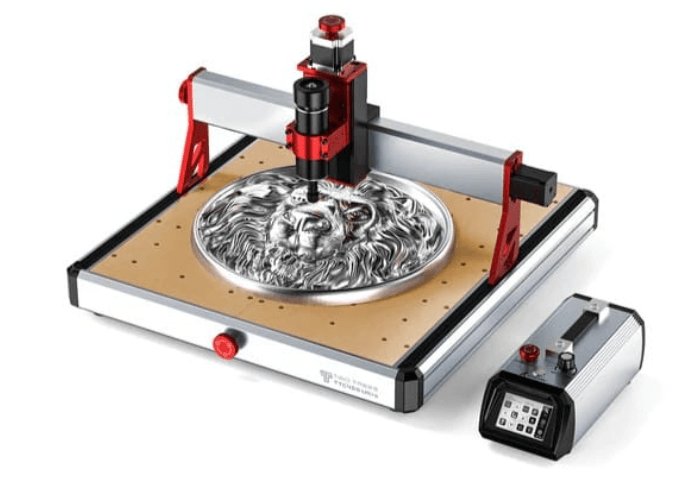
For workshop setups requiring substantial carving clearance, the TTC-H40 CNC router offers an expansive 1000mm1000mm100mm working envelope.
[1000x1000mm Work Envelope] ──> [500W High-RPM Spindle] ──> [3.5″ Standalone Touchscreen]
Key Highlights of the TTC-H40:
- Generous Workspace: The 1000mm1000mm bed fits standard half-sheet plywood and large hardwood panels, eliminating the need to cut stock down beforehand.
- Heavy-Duty Spindle: The included 500W spindle handles adjustable speeds between 8,000 and 30,000RPM, providing the torque needed for cutting dense hardwoods, MDF, acrylic, and soft non-ferrous metals like aluminum.
- Flexible Control Options: Open-source GRBL firmware ensures native compatibility with CAM software such as Easel, Fusion 360, and Carveco Maker. Offline carving is supported via the 3.5-inch integrated touchscreen and TF card reader.
Getting Started: Essential Workflow Steps
[Design / CAD] ──> [CAM Toolpaths & Feeds] ──> [Workpiece Clamping] ──> [Zero Z-Axis] ──> [Run Carve]
- Prepare Stock & Secure Workholding: Secure your material flat to the spoilboard using T-track clamps or double-sided painter’s tape to prevent movement during cutting passes.
- Select Tooling & Calculate Feeds/Speeds: Match end mills to the material (e.g., 2-flute spiral end mills for wood, single-flute for acrylic). Adjust feed rates to ensure proper chip removal rather than rubbing.
- Set Zero & Test Run: Reference your X,Y, and Z zero points accurately. Running an air pass above the workpiece verifies that motion paths stay within physical limits before cutting begins.